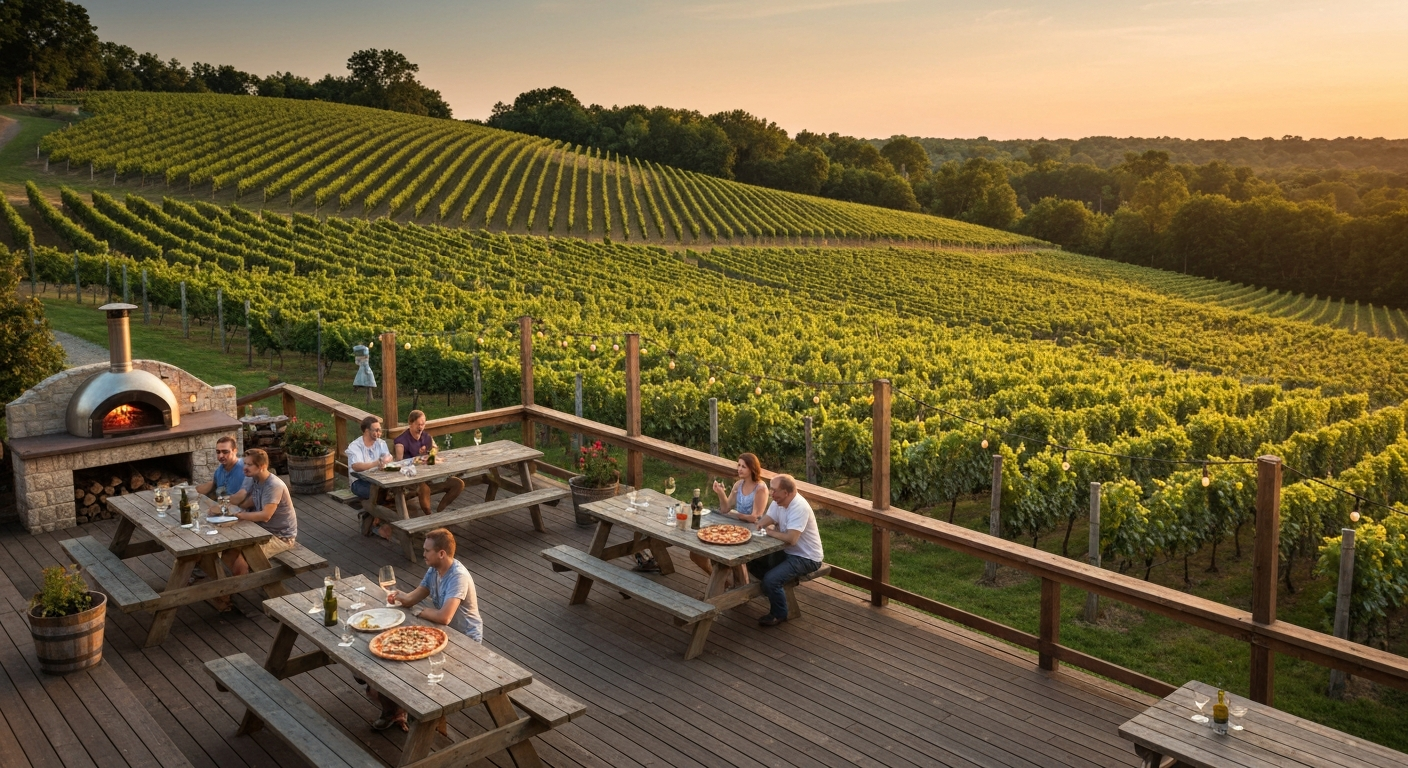
The best winery patios share a handful of non-negotiable qualities: genuine outdoor exposure to the vineyard or landscape, reliable food service alongside the tasting menu, shade or shelter when the afternoon sun gets serious, and staff who actually know the wine list. Whether you're chasing a sunset pour in Niagara-on-the-Lake or hunting a dog-friendly terrace on a long weekend road trip, those fundamentals hold true across every region. This guide covers what to look for, how to filter and find great winery patios using Best Patios Near Me, and how to plan a visit that doesn't leave you squinting into the sun with an empty glass and nowhere to sit.
Best Winery Patios: Find Top Outdoor Tasting Spots Across U.S. & Canada

Jonah Farrell
6 Aug 2026
What this guide is actually for
Winery patios occupy a unique space in the patio-hunting world. They're not just outdoor seating attached to a bar or restaurant. They're a whole experience: the rows of vines in the background, the deliberate calm, the food-and-wine pairing, the long golden hours of a Saturday afternoon. But they also come with quirks. Some require reservations weeks in advance. Some only do tastings, no food. Some are exquisite but brutally exposed to wind or afternoon glare. This guide is for patio hunters and travelers who want to show up prepared, not disappointed. It's also a working reference for how Best Patios Near Me builds and presents city and neighborhood pages for winery patios, so you can use those pages as efficiently as possible.
The 10 attributes of a genuinely great winery patio
I've developed this checklist through a lot of trial and error. Most of the disappointments I've had on winery patios came down to one item from this list being missing. Run any candidate venue against these ten before you book.
- Outdoor seating with a meaningful view: vineyard rows, gardens, water, or open landscape. A 'patio' that faces a parking lot doesn't count, no matter how nice the wine is.
- Food service alongside tastings: charcuterie, a proper lunch menu, food-truck partnerships, or at minimum a credible cheese board. Wine without food mid-afternoon is a one-way ticket to a headache.
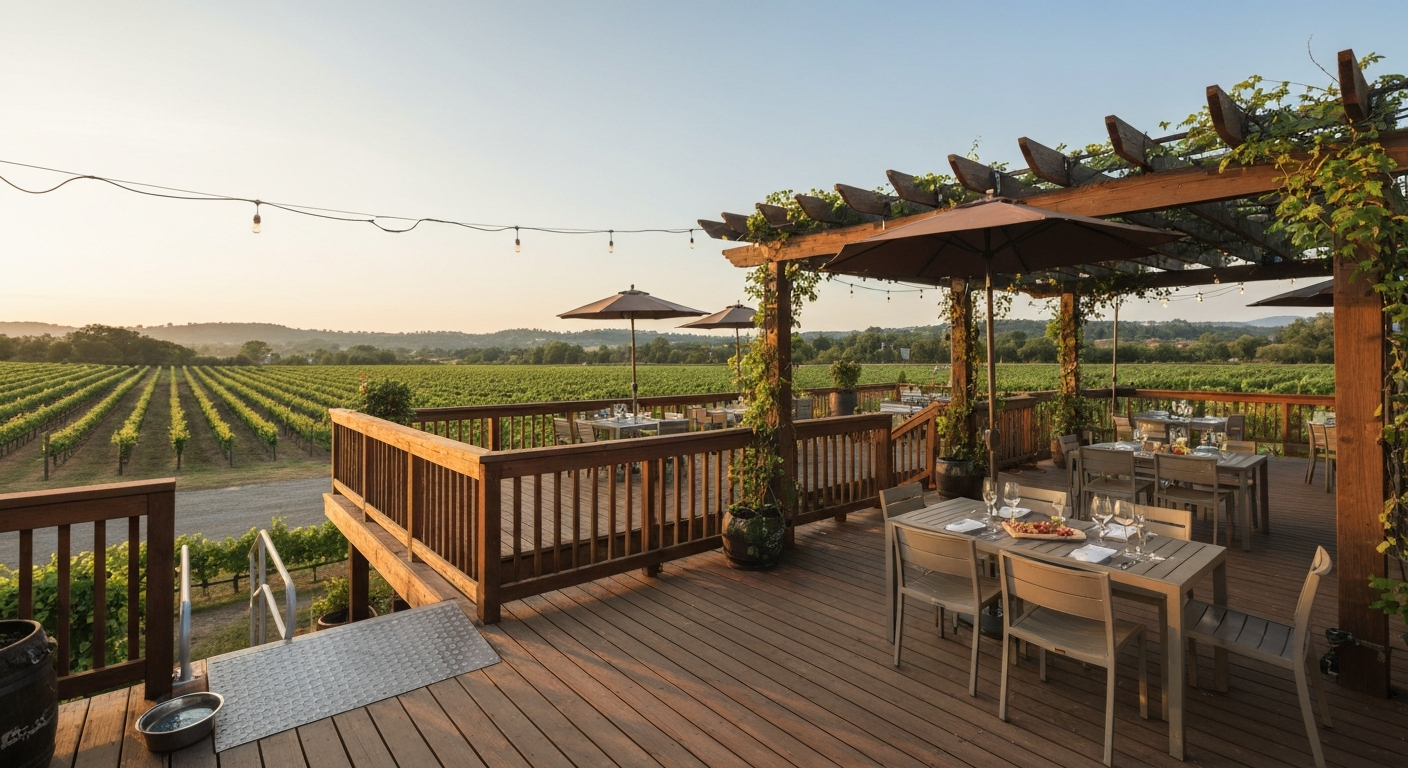
- Shade and shelter options: a pergola, umbrellas, mature trees, or a partial roof. Direct afternoon sun makes wine taste flat and guests uncomfortable within 20 minutes.
- Wind protection: a natural break, hedges, or a partial enclosure. Especially critical in exposed Niagara and prairie settings where wind can kill a patio experience fast.
- Dog-friendly seating section: a clearly designated area where leashed dogs are welcome. Not just 'we don't mind' but actual water bowls and a defined zone.
- Accessible entry and seating: level or ramped access from the parking area, and at least some all-weather surface seating that works for wheelchairs and strollers.
- Adequate parking close to the patio entrance: winery parking varies wildly. Gravel lots 400 metres from the door are common; it matters more when guests are carrying mobility aids, strollers, or large picnic orders.
- Reservation policy that's clearly stated: walk-in only, reserved only, or a split. Knowing in advance saves a wasted trip during peak season.
- Seasonal readiness: heaters or fire pits for shoulder-season visits, plus a clear opening date in spring and closing date in fall. In Canada, that window is typically May through October based on Environment and Climate Change Canada climate normals for most regions.
- Staff knowledge of the wine list and food pairings: this is what separates a winery patio from just a field with a table in it. The conversation with a knowledgeable server or tasting-room host is half the experience.
What actually defines winery-patio quality
Quality on a winery patio is more nuanced than 'nice view and good wine,' though both matter. Let me break down the dimensions worth evaluating before you commit an afternoon.
Views and layout
The layout of the patio determines how many tables actually get the view versus how many are stuffed near the kitchen exit. A well-designed winery patio orients most of its seating toward the vineyard or landscape, not toward the building facade. Look for elevated decks, wraparound terraces, or tiered seating that gives even the back tables a sightline. When I'm checking a venue for the first time, I look at photos from the back corner of the patio, not the hero shot. That's what most guests actually experience.
Noise and crowd energy
Winery patios vary more in vibe than people expect. Some are almost meditative, low music, hushed conversation, serious tasting energy. Others run live music events on weekends and are genuinely lively and social. Neither is wrong, but they serve different needs. A first date and a large family celebration call for different crowd energy. Check whether the venue hosts events on the day you plan to visit. That can flip a quiet tasting patio into a loud outdoor concert venue with very little warning.
Service quality and pace
Winery patio service is often slower than restaurant service, by design, and that's fine if you're settling in for two hours. It's not fine if you're doing a quick lunch stop. Ask when you book whether the kitchen runs a full lunch service or a limited tasting-room menu. Some wineries bring in food trucks on weekends, which can mean limited hours or sell-outs by 2pm. That's the kind of detail worth a quick phone call or a check of the venue's Google Business Profile before you drive out.
Shade, sun angle, and wind
The sun angle in late afternoon is genuinely brutal on patios that face west with no shade. I've had patio sessions where we moved three times chasing the shadow of a single umbrella. Covered pergolas with climbing vines are the gold standard for winery patios: they diffuse light, reduce heat, and look beautiful. Fixed shade sails are the practical runner-up. Freestanding umbrellas are the minimum. No shade at all, on any patio operating through summer peak hours, is a design failure. Wind protection matters especially in Niagara, Ottawa, and any prairie or lakeshore setting, where gusts can knock over wine glasses and send menus airborne. A solid hedgerow, low stone wall, or wooden screen makes an enormous difference.
Safety and accessibility
Gravel or grass surfaces are common on winery properties and can be challenging for wheelchairs, walkers, and strollers. Ontario's AODA standards require accessible paths to public spaces, and the U.S. ADA sets equivalent requirements for places of public accommodation. When we flag a patio as accessible on Best Patios Near Me, we mean paved or compacted-surface path from the accessible parking spot to the patio seating, with at least some level hard-surface seating available. Worth calling ahead to confirm the route if accessibility is a priority for your group. On the dog-friendly question: under U.S. ADA rules, trained service animals must be permitted in all public areas regardless of a business's general pet policy. In Canada, provincial human rights codes carry equivalent protections. A business that says 'no dogs' can still not turn away a service animal.
Practical attributes and filters worth using
When you're actually searching for a winery patio rather than just dreaming about one, these are the practical filters that will save you time and prevent a wasted afternoon.
- Dog-friendly: look for venues that explicitly list a pet-welcome policy, not just silence on the subject. A confirmed dog-friendly designation means leashed dogs are welcome in the patio area, with water available.
- Lunch and food availability: filter for venues with full food menus or confirmed food-truck partnerships, and check operating hours for the kitchen separately from the tasting room. These often differ.
- Covered vs. open seating: covered patios (pergola, awning, partial roof) extend the usable season significantly and make afternoon visits more comfortable. Open patios are weather-dependent.
- Heated seating for shoulder season: propane heaters, fire pits, or infrared heating panels allow shoulder-season visits in April-May and September-October across most Canadian and northern U.S. regions.
- Seating types: tables and chairs for dining vs. lounge-style seating vs. picnic benches. Lounge seating is comfortable for tasting flights; it's awkward for a proper lunch.
- Reservations required or walk-in welcome: peak-season winery patios in destination regions like Niagara fill weeks in advance. Knowing the reservation policy before you go is non-negotiable.
- Restroom access from the patio: sounds obvious, but on large winery properties the restroom can be inside the main building, a long walk from the patio. Worth noting especially for groups with kids.
- Proximity to parking: the gap between the parking area and the patio varies enormously on winery properties. Gravel paths can stretch 200 to 400 metres.
Winery patio attributes at a glance
Use this comparison framework when evaluating any winery patio. The table reflects the key filters we use on Best Patios Near Me to sort and present venues. Not every winery will tick all boxes, and that's fine. Use it to match the patio to your specific priorities for the visit.
| Attribute | What to look for | Why it matters | How to verify |
|---|---|---|---|
| Dog-friendly | Designated pet area, water bowls, leash policy posted | Saves a wasted trip with your dog; service animals always permitted regardless | Check venue website; call ahead to confirm current season policy |
| Food service | Full lunch menu, charcuterie boards, food truck on-site | Sustains a longer visit; affects alcohol service rules in some jurisdictions | Review online menu; check hours separately from tasting room |
| Covered seating | Pergola, awning, shade sail, or partial roof over at least some tables | Extends usable season; comfort in heat and light rain | Photo review; check venue description on booking platform |
| Accessibility | Paved or compacted path, accessible parking close to patio, level seating | Required under ADA (U.S.) and AODA (Ontario) for compliant venues | Call venue; check Google Business Profile wheelchair attribute |
| Parking | On-site lot within reasonable walking distance of patio entrance | Critical for larger groups, mobility needs, or wine-to-go purchases | Google Maps satellite view; venue FAQ or directions page |
| Peak season suitability | Shade, wind protection, heaters for shoulder season, reservation window | Determines whether venue works for your travel dates | Cross-reference NOAA or Environment Canada climate normals with venue open dates |
How to find and filter winery patios on Best Patios Near Me
The site is built around the idea that you shouldn't have to visit five different platforms just to answer the question 'is there a dog-friendly winery patio with lunch near me this Saturday?' Here's how to use it efficiently.
- Start with the map view: open the map and zoom to your target area, whether that's a specific city, a wine region like Niagara, or a neighborhood. The map clusters mark patio-equipped venues with venue-type icons. Winery patios show up under the 'Winery' venue type filter.
- Apply the venue type filter first: select 'Winery' from the venue-type dropdown to exclude restaurants and bars and focus the results on wine-specific venues. This is the fastest single filter to apply.
- Layer in practical filters: once you have the winery view, apply secondary filters for dog-friendly, food service, covered seating, and accessibility. Each filter narrows the results to venues that have confirmed that attribute.
- Use the neighborhood pages for context: city pages are organized by neighborhood, so if you're visiting a wine region, browse the regional or neighborhood page for curated context including local events, seasonal notes, and user-submitted photos. Niagara-on-the-Lake, for example, has its own dedicated page with winery-specific patio listings.
- Sort by rating or recently reviewed: sorting by recently reviewed surfaces venues with current-season confirmation, which matters because hours, food menus, and pet policies change seasonally.
- Save your shortlist: use the saved-lists feature to bookmark three to five candidates before your trip, then check hours and reservations the morning you plan to visit.
- Check the opening-hours panel: each venue card shows hours pulled from the venue's Google Business Profile. Look for seasonal hours or secondary hours noting when the patio specifically opens, which sometimes differs from the main tasting-room hours.
- Read the most recent reviews for patio-specific notes: sort reviews by 'most recent' and scan for mentions of current shade conditions, food quality, wait times, and dog-friendliness. These real-time notes are often more accurate than the static venue description.
Search templates that actually work
Whether you're a local doing a quick search or a traveler planning a route through wine country, having a reliable query structure saves time. These templates are built around the way the site's filters and neighborhood pages are organized.
- [City] + winery patio + dog-friendly: the core query for pet-owner visitors. Example: 'Niagara-on-the-Lake winery patio dog-friendly' or 'Ottawa winery patio dog-friendly.'
- [Region] + winery patio + lunch: targets venues with confirmed food service. Example: 'Niagara wine region winery patio lunch' or 'Windsor Ontario winery patio lunch.'
- [City] + winery patio + covered seating: finds weather-resilient options. Especially useful for shoulder-season travel to Winnipeg or Ottawa.
- [Neighborhood] + winery patio + open now: surfaces venues currently operating. King West in Toronto returns wine bar-adjacent patios with similar energy to winery terraces.
- [City] + winery patio + accessible: returns venues with confirmed accessible seating and path. Essential for visitors with mobility needs.
- [Region] + best winery patios + [month]: surfaces seasonal recommendations. Climate normals vary significantly by region: May through September is reliably patio-friendly across most of Ontario and the northern U.S. Midwest; shoulder months (April, October) warrant checking heater availability.
- [City] + winery patio + reservations: filters for venues confirming reservation options through integrated booking partners like OpenTable, Resy, or Tock.
Planning your visit: timing, reservations, and weather
Most winery patios in Canada operate between mid-May and Thanksgiving weekend in October, which aligns with the 1991-2020 climate normals published by Environment and Climate Change Canada showing reliably mild temperatures through that window in Ontario, Quebec, and British Columbia wine regions. In U.S. wine regions, NOAA NCEI normals support an April-through-October window for most northern states, with year-round operation in California, Texas, and the Southeast.
Reservations are non-negotiable at most destination winery patios during peak season. Platforms like OpenTable, Resy, and Tock are the fastest way to check availability and book without a phone call. For venues not on booking platforms, a direct call is faster and more reliable than an email request. When I'm planning a visit to a region I don't know well, I call the venue, ask specifically about the patio (not the tasting room, the patio), confirm the food menu hours, check on whether my dog is welcome, and ask about parking. That five-minute call has saved me from several frustrating surprises.
In Ontario, wineries serving alcohol on outdoor patios are regulated by the Alcohol and Gaming Commission of Ontario. AGCO guidance 'Temporary Outdoor Physical Extensions (Temporary Patios)' details the rules and notification requirements for Ontario liquor-licence holders Temporary Outdoor Physical Extensions (Temporary Patios) — AGCO. Expanded outdoor patio areas require proper licensing and sometimes municipal approval, which is why some winery patios shrink or change layout from year to year. If a patio you visited last season looks different, that's often the reason. Toronto-area urban patios are additionally subject to the city's CafeTO program rules for any seating on public or curb-lane space, though most winery-adjacent urban wine bars use private property patios.
City-page template: how Best Patios Near Me presents winery patios
Every city and neighborhood page on Best Patios Near Me follows a consistent structure designed to answer the questions that actually matter before a visit. Here's the template, with notes on how we apply it to winery patio pages specifically. This isn't a list of specific venue endorsements; it's the reusable framework we use to build each page so you know what to expect when you land on one.
Template structure
- Short location intro (2 to 3 sentences): where the city or neighborhood sits in a wine region, what makes its patio culture distinctive, and the typical patio season window based on local climate normals.
- Neighborhood context: a note on which neighborhoods or sub-regions have the highest concentration of winery patios, and how to navigate between them (drive, bike trail, shuttle).
- Top patios section: curated list of standout venues with the following fields for each: name, address, patio type (open/covered/partial), dog-friendly status, food service confirmation, reservation link or platform, accessible entry yes/no, parking notes, and peak season hours.
- Hours and seasonal notes: patio-specific operating hours, confirmed opening and closing dates for the current season, and any event-specific schedule changes.
- Reservation tips: booking window lead time for peak season, preferred platforms, and whether walk-in seating is typically available at off-peak hours.
- Local tips and trade-offs: honest notes on the scene (lively vs. quiet, upscale vs. casual pricing, best time of day for shade, which tables to request).
Example fields by city
Here's how the template applies to the key destinations we cover, including the Niagara wine regions, Ottawa, Winnipeg, King West, and Windsor. For a curated list of options, see our Windsor page for best patios Windsor, Ontario (listing ID 2e705efd-fbbf-4f6e-96a9-776d49b639f3). For a curated list of top outdoor spots in the city, see Best Patios Ottawa. For neighborhood-specific listings and patio details, see our Best Patios King West city page for curated King West patios and neighborhood notes. See our curated list of the best winery patios in Niagara-on-the-Lake for vineyard-terrace recommendations and booking details best winery patios niagara on the lake. For curated listings and neighborhood recommendations, see our page on best patios in Winnipeg. Each of these has a dedicated page on Best Patios Near Me, and the winery-focused pages for Niagara-on-the-Lake specifically drill down into vineyard-terrace experiences that are distinct from general patio listings.
| City / Area | Patio season window | Key winery patio note | Dog-friendly landscape | Reservation lead time |
|---|---|---|---|---|
| Niagara-on-the-Lake | May to mid-October | High concentration of estate winery terraces with vineyard views; separate dedicated winery patio page available on the site | Many wineries allow leashed dogs on patio; confirm per venue | 2 to 4 weeks in summer peak |
| Ottawa | Mid-May to late September | Mix of urban wine bars with patios and day-trip winery routes in nearby regions; strong brunch and lunch patio culture in the Glebe and Westboro neighborhoods | Variable by venue; urban patios more likely dog-friendly | 1 to 2 weeks for popular spots |
| Winnipeg | Late May to early September (shorter window due to climate) | Limited dedicated winery patios; focus on patio bars and restaurants with curated wine programs; heated patios extend the season | Several dog-friendly patios in the Exchange District and Osborne Village | Often walk-in; call ahead for weekends |
| King West (Toronto) | April to October with heated patios | Urban wine bars and upscale patios with strong wine lists rather than estate wineries; high energy, later evening crowd, excellent food menus | Some patios dog-friendly; smaller footprints so capacity is limited | 1 to 3 weeks for weekend reservations |
| Windsor, Ontario | May to October | Cross-border proximity to Michigan wine routes adds visitor interest; local patios with good wine programs worth exploring for day trips | Variable; worth a direct call to confirm | Usually 1 week or less except holiday weekends |
| Niagara wine region (broader) | May to Thanksgiving weekend | The densest wine-country patio destination in Eastern Canada; multiple estate winery terraces with full lunch menus, cooking demos, and harvest-season events | Many estates welcome leashed dogs; some designated patio sections with water bowls | 3 to 6 weeks during July-August peak |
Food, wine, and what to actually eat out there
A winery patio without food is a setup for an unpleasant afternoon. The best winery patios run a proper lunch menu, not just crackers from a cellophane packet. Look for venues offering charcuterie boards built around local meats and cheeses, flatbreads or light mains that pair with the tasting flights, and seasonal salads that reflect the growing region. Food trucks are increasingly common partners on winery properties on weekends, especially in Ontario, and when they're well-matched to the wine program they're genuinely excellent. The key thing to check: whether the food service runs the same hours as the patio. It's frustratingly common to show up at 3:30pm on a Sunday and find the kitchen closed but the tasting room still happily pouring. Food safety for on-site kitchens and food-truck partners at winery patios is governed in the U. See the 2022 Food Code, U.S. FDA (Model Food Code) for the model standards many U.S. jurisdictions adopt for retail food safety, temporary food operations, and mobile food units 2022 Food Code — U.S. FDA (Model Food Code). S. by adopted versions of the FDA Model Food Code, and locally by health department temporary-event permits, so established venues have a clear compliance framework, but smaller seasonal pop-up kitchens can have limited hours.
How to contribute a winery patio to the site
Best Patios Near Me grows through community contributions as much as through our own curation. If you've found a winery patio we haven't listed yet, or you want to update details on an existing listing, here's how it works and what makes a submission useful.
- Basic venue information: name, full address, and website URL. These allow us to cross-check against Google Business Profile and confirm the listing is active.
- Patio-specific attributes: confirm whether the patio is covered or open, dog-friendly, accessible, and whether food service is available. Don't leave these blank: they're the filters most users rely on.
- Current hours: include both tasting-room hours and patio-specific hours if they differ. Seasonal open and close dates are especially useful for our city-page seasonal notes.
- Photos from the patio itself: a clear photo from the seating area showing the view, seating type, and shade situation is worth more than a hero shot of a wine glass.
- Reservation platform: note whether the venue is on OpenTable, Resy, Tock, or another platform, or whether they take reservations by phone only.
- Verification step: before submitting, check the venue's own website and cross-reference Google Business Profile to confirm the details are current. If anything conflicts, a quick phone call to the venue is the best way to resolve it. We follow a three-step verification process: official website first, booking platform and Google Business Profile second, direct phone confirmation for anything that still conflicts.
Reviews submitted to the site follow content guidelines similar to major platforms: first-hand experience only, no promotional content from owners or affiliated parties, and specific practical detail (seating, food, accessibility, dog policy) weighted over general impressions. The more concrete your review, the more useful it is for other patio hunters making decisions. A note like 'covered pergola section at the back has shade from 2pm onward and the Pinot was excellent with the charcuterie board' is genuinely more helpful than 'great vibe, would recommend.'
Go find your next favorite patio
The best winery patio you've visited is probably not the last great one you'll find. New estate terraces open every season, existing wineries expand their patio programs, and food partnerships keep improving the lunch experience across all the major wine regions. Use the checklist, run the filters, make a reservation, bring your dog if the venue allows it, and stay longer than you planned. That's usually when the best winery patio memories get made: the unplanned second pour, the conversation that stretched into the golden hour, the view that looked even better than the photos. That's what we're here to help you find.
FAQ
What core data fields should I collect for each winery patio to build an accurate, city-linked listing and comparison table?
Collect stable identifiers and location (Google place_id, lat/lng, formatted_address), contact (phone, website, email if available), hours (regular + special/seasonal hours), reservation channels (OpenTable/Resy/Tock/venue widget), price level, average rating and review count, photos, patio attributes (outdoor seating type: covered/uncovered, heated/outdoor heaters, capacity), pet policy (dog-friendly, service‑animal rules), food options (kitchen hours, menu link, food trucks), accessibility features (wheelchair_accessible_entrance, accessible path, accessible washroom), parking (onsite, street, valet, transit access), permit/status (temporary patio permit or municipal program), seasonal notes (typical open months), events/private‑booking availability, and verification metadata (sources checked and last-verified timestamp). These fields map directly to Google Place Details and reservation-platform data for automated population in a comparison table.
Which authoritative sources should I use to verify venue facts such as hours, pet policies, menus and patio permits?
Primary sources: the venue’s official website and menu pages, the venue’s Google Business Profile / Google Places Place Details, and direct phone contact with the venue (owner/manager). Secondary/confirming sources: reservation platforms (OpenTable, Resy, Tock, Yelp Reservations), municipal patio programs and permits (city pages like CafeTO), provincial/state liquor authorities (e.g., AGCO in Ontario), and local public-health/food-safety pages (adopted Food Code). For weather/seasonal norms use NOAA (U.S.) and Environment and Climate Change Canada. For legal pet/accessibility context use ADA guidance (U.S.) and provincial standards like Ontario’s AODA.
What step-by-step verification workflow ensures accurate, up-to-date patio listings?
1) Scrape/collect saved facts from Google Places Place Details and reservation APIs (store place_id + timestamps). 2) Check the venue’s official website for menus, hours, patio photos and policy statements. 3) Cross-check booking platforms for reservation rules and popular seatings. 4) Call the venue to confirm mission‑critical facts (current hours, pet policy, exact patio availability, parking, accessibility). 5) If municipal permits or temporary patios are involved, verify permit status on the city’s permit program page. 6) Record all sources, the verifier’s name and date/time. 7) Re-verify automatically or manually on a cadence (e.g., high-traffic patios monthly; low-traffic patios quarterly) and flag any conflicts for follow-up. Use the Verification Handbook guidance for decision rules when sources conflict (official venue or direct contact trumps third-party listings).
How should I integrate Google Places (Place Details) and reservation platforms into city pages and the Best Patios Near Me search/filter features?
Use Place Details to populate map pins, canonical contact info, opening_hours, photos, place_id (stable key), geometry and wheelchair_accessible_entrance. Pull reservation links or availability widgets from OpenTable/Resy/Tock and display prominently. In the Best Patios Near Me UI implement filters for venue-type (winery vs. wine bar), dog-friendly, reservation_required, lunch_service, covered_heating, accessible, and neighborhood. Drive 'neighborhood page' creation by clustering venues by lat/lng into city-defined neighborhoods and surface permit/program notes (e.g., CafeTO). Respect rate limits and API terms; cache results and store verification timestamps.
What verification and regulatory checks are necessary when recommending patios that serve alcohol or food?
Confirm liquor service permissions via the applicable liquor/regulatory authority (e.g., AGCO in Ontario) for temporary patios or outdoor extensions. Verify food handling and vendor legitimacy against local public‑health temporary vendor rules and the adopted Food Code. For on-site kitchens and food trucks, confirm that the venue or vendor holds the appropriate food-service permits. Document the source of each regulatory confirmation (license number, permit page link) and include any known limitations (seasonal or temporary approvals).
Which climate and seasonal data should be used to recommend the best months for patio visits and weather planning?
Use NOAA NCEI U.S. Climate Normals for U.S. cities and Environment and Climate Change Canada normals for Canadian cities to identify typical monthly temperatures and precipitation. Combine normals with current seasonal advisories (from local meteorological services) for short-term visit planning (e.g., late-spring chill, summer storms). Present recommended windows (e.g., May–September) with caveats about microclimate and venue-specific heating/covering features.
Next Article
Best Winery Patios Niagara-on-the-Lake: Top Outdoor Picks
Discover the best winery patios in Niagara-on-the-Lake: top terraces, menus, dog-friendly spots, hours & booking tips.