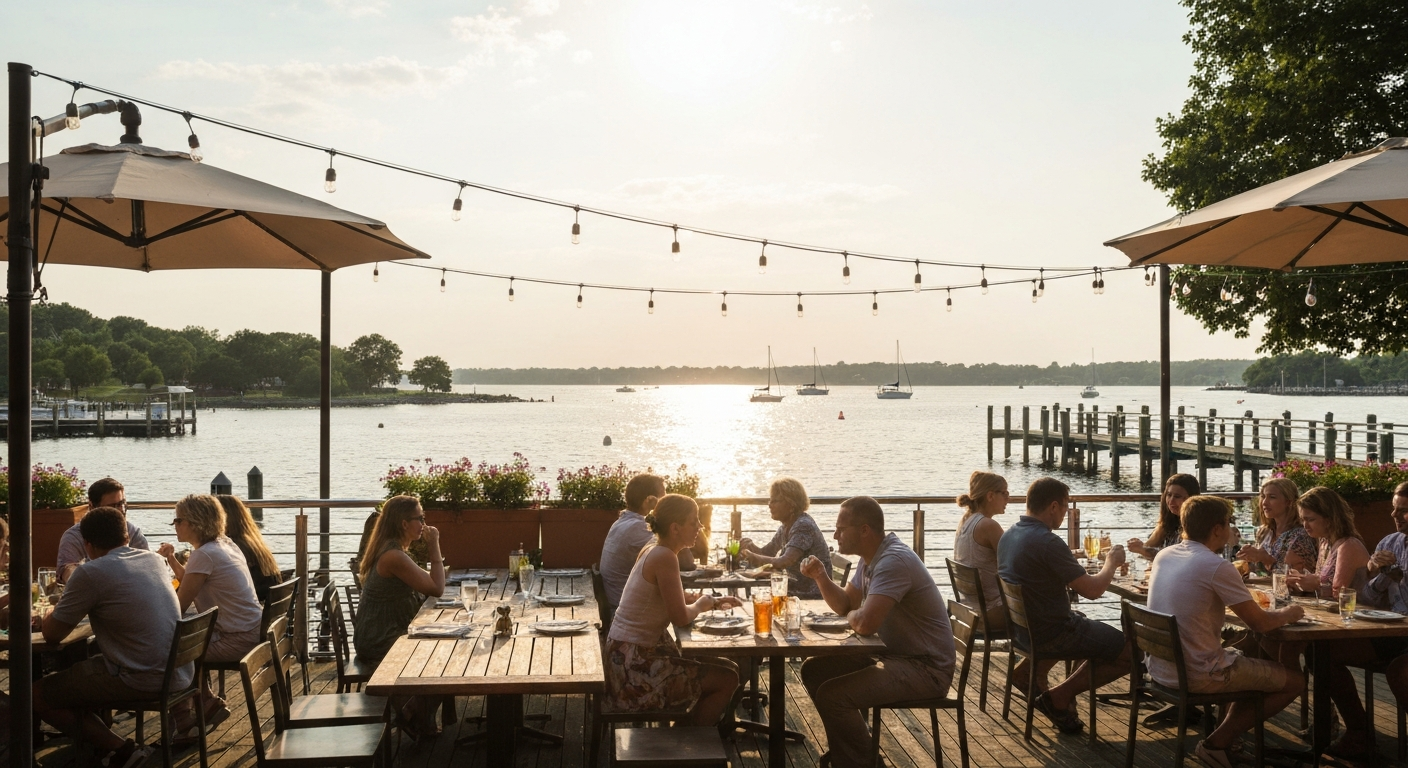
The best patios nearby are the ones that combine real outdoor seating, a vibe that matches your mood, and a location you can actually reach in the next hour. Whether you are a local looking for a new happy-hour spot or a traveler wanting to eat outside instead of staring at a hotel wall, the fastest way to find them is through a directory that lets you filter by distance, outdoor attributes, and the specific things you care about, dog-friendly, waterfront, covered, cheap, or all four at once. For an easy search experience, try our directory view for best patios near me with outdoor seating that filters by distance, cover type, and dog-friendly options.
Find the Best Patios Nearby: Guide to Outdoor Dining & Filters

Jonah Farrell
29 Jul 2026
What 'best patios nearby' actually means
It sounds simple, but 'best patios nearby' is doing a lot of work in three words. Let me break it down, because the way a good directory defines this directly shapes the results you get.
'Nearby' means measurable distance from where you are right now, or from a specific neighborhood or city you type in. It is not a vague editorial call. A practical definition anchors every result to a lat/lng coordinate and ranks by either strict proximity (closest first) or a blended score that weights proximity and popularity together, the same way Google's Places API offers both 'rankby=distance' and a 'prominence' mode. For most diners, a mix works best: you want places within a walkable or short-drive radius, but among those, you'd rather see the well-rated ones first.
'Best' should be measurable, not vibes-only. A good patio directory scores venues across five concrete domains: verified outdoor seating (not just a listing that says 'patio' somewhere in the description), proximity, ambiance quality based on ratings and recent photos, service signals like reservation availability and typical wait times, and price range. These are the same attributes that major platforms like OpenTable and Google Business Profile expose as structured, searchable fields.
'Patios' specifically means genuine outdoor seating, not a single sidewalk table or a cramped fire escape. The attribute you want confirmed is 'outdoor seating: yes,' and ideally something more specific: covered or uncovered, heated or not, seasonal or year-round. A great directory flags this clearly rather than burying it in a paragraph of marketing copy.
Quick-start: search by city, neighborhood, or your current location
There are three ways to start a patio search, and each suits a slightly different situation. City-level searches are best when you are planning ahead, visiting a new place next weekend and want to read through options before you go. Neighborhood searches get more surgical: 'patios in Capitol Hill' or 'outdoor dining in the French Quarter' pulls results tight to a specific area, which matters when you have a hotel to walk back to or a parking spot you don't want to lose. The 'near me' search is for right now, you're hungry, you want outside, and you want the three closest options on a map. For an immediate list of options, try a 'good patios near me' search to surface nearby patios ranked by distance and relevance.
The 'near me' feature works through your browser's Geolocation API, which asks for your permission before sharing your device location. If you grant it, the directory pins your position and returns results ordered by distance. If you'd rather not share your location (totally reasonable), you can always just type a cross street, neighborhood name, or zip code instead. Either way, the core search engine uses geocoding, converting your text input or device coordinates into a precise map point, to anchor every result to real-world distance. Mapbox's geocoding APIs can deliver rooftop-level accuracy where coverage allows and its API Docs | Mapbox also document rate-limit behavior and recommend client-side measures like caching, exponential backoff, and request-budgeting for high-throughput 'near me' queries.
Step-by-step search strategy: from city lists to neighborhood gems
I've developed a search routine that consistently surfaces places I'd never find by just scrolling a generic map app. Here's how it works in practice.
- Start with a city-level search to get a sense of the full landscape. Browse the top-rated outdoor venues by overall score and look for patterns — are there clusters in a particular neighborhood? Are certain venue types (breweries, rooftop bars) dominating the results?
- Zoom into a neighborhood or district that makes sense for your day. This narrows your options without overwhelming you and keeps travel time predictable.
- Apply one or two non-negotiable filters right away — dog-friendly if you have a pup, waterfront if that's your priority, or 'open now' if you're searching in real time.
- Sort by highest rating within the filtered set to find the places that locals consistently return to, not just the ones closest to a major tourist street.
- Open three to five results and check photos first. Recent user photos (within the past six months) tell you more about the actual patio than a venue description ever will.
- Confirm hours, menu, and outdoor seating availability directly on the venue's own website or reservation widget before you commit. Attributes can go stale, and a quick check takes thirty seconds.
That last step matters more than people think. Google Business Profile and Yelp allow verified venue owners to update their own attributes, which is more reliable than unaffiliated user edits. See Add attributes | Google Business Profile APIs | Google for Developers for details on how venue owners can update and verify business attributes through Google's API. But seasonal changes, a patio that closes in October or only runs a heater until the end of March, don't always get updated in time. Treat the directory as a shortlist engine and use the venue's own site for final confirmation.
Using filters to zero in on exactly what you want
Filters are where a patio directory earns its keep. The difference between a generic restaurant app and a dedicated patio guide is the depth of outdoor-specific attributes you can actually search on. Here's the filter set that covers most situations, and what each one really tells you.
| Filter | What it tells you | Best used when |
|---|---|---|
| Outdoor seating: yes/partial/seasonal | Whether there is a confirmed patio at all, and how reliably it's available | Every search — this is the baseline filter |
| Covered/uncovered | Whether you'll be exposed to direct sun or rain | Hot summer days, unpredictable weather cities |
| Heated/outdoor heaters | Year-round usability in cool climates | Spring/fall shoulder seasons, evening dining |
| Shade structures | Umbrellas, pergolas, or tree cover for daytime comfort | Lunch searches in sunny climates |
| Waterfront/view | River, lake, ocean, or skyline orientation | Special occasions, sunset dining |
| Dog-friendly | Whether dogs are allowed on the patio specifically | Any time you have a pup with you |
| Live music | Scheduled or regular acoustic/live performances outdoors | When energy and entertainment matter |
| Wheelchair accessible | Ramp/level access to outdoor seating area | Essential for guests with mobility needs |
| Price level ($–$$$$) | Rough spend-per-person range | Budget planning, date nights vs. casual lunches |
| Cuisine type | Food style served | Narrowing to a specific craving |
| Reservations accepted | Whether you can book ahead vs. walk-in only | Weekend evenings, large groups |
| Open now / lunch service | Real-time or time-of-day availability | Spontaneous mid-day searches |
A practical tip: don't stack every filter at once. Start with two or three that are genuinely non-negotiable, then browse the results before adding more. Over-filtering a smaller city or neighborhood can zero out the results entirely and make you think there are no good options when actually there are plenty that score well on most of your criteria.
Specialty searches worth their own moment
Dog-friendly patios
Dog-friendly patios are their own category of great, there is something genuinely lovely about a brewery patio where your dog is as welcome as you are. The key thing to verify beyond the 'dogs allowed' attribute is whether dogs are allowed at the patio specifically (not just on the sidewalk out front) and whether the venue has water bowls or shaded spots. Many places that list themselves as pet-friendly in Texas or California have fully dedicated dog-run areas; others just tolerate leashed dogs at a couple of tables. Recent photos from other dog owners are your best reality check here. See our list of best dog friendly patios for curated options and real-user photos.
Waterfront patios
Waterfront patios range from a dock table at a lakeside fish shack to a rooftop bar with a river view eight floors up. The 'waterfront' filter catches both, so it's worth scanning the photos to understand what kind of water access you're actually getting. For a quick list you can filter by distance, view photos, and confirm water access, search best waterfront patios near me. Direct waterfront (where you can see and hear the water from your table) is a very different experience from 'water visible if you stand at the railing.' Sunset timing matters a lot with these spots, checking the venue's west-facing orientation in satellite view before you go is the kind of small move that turns a good dinner into a great one.
Shaded and heated patios
In cities like Phoenix, Austin, or Miami in summer, shade isn't a luxury, it's a basic comfort requirement. Look specifically for 'covered patio' or 'shade structures' rather than just 'outdoor seating', a south-facing uncovered concrete slab at 2pm in July is technically outdoor seating, but it's not a pleasant lunch. Heated patios on the other side of the calendar, think Chicago in October or San Francisco in basically any month, extend the outdoor season significantly. Infrared heaters and enclosed pergolas can make a 50-degree evening perfectly comfortable.
Restaurants vs bars vs breweries vs cafes: picking the right venue type
The venue type shapes your whole experience, not just the menu. Here is an honest breakdown of the tradeoffs.
| Venue type | Patio vibe | Typical price range | Best for | Watch out for |
|---|---|---|---|---|
| Restaurant | Curated, often quieter; tablecloths or candles possible | $$–$$$$ | Dinner occasions, date nights, full meals | Reservation required on weekends; patio may be smaller than the indoor section |
| Bar | Lively, social, often standing-room mixed with tables | $–$$ | Happy hour, casual groups, people-watching | Can get loud; patio may close early if noise ordinances apply |
| Brewery / taproom | Relaxed, communal tables, often dog-friendly | $–$$ | Afternoons, dogs, groups with varied drink preferences | Food options can be limited to food trucks or snacks only |
| Cafe | Quiet, daytime-focused, often shaded sidewalk or garden | $ | Breakfast, working lunches, solo dining | Patio seating limited; may not take reservations |
| Food truck park | Casual, mix-and-match, often large open-air areas | $ | Families, groups with different cravings, events | Weather exposure; seating can be first-come-only |
My honest recommendation: if outdoor ambiance is the primary goal rather than a specific dish or drink, breweries and taprooms consistently punch above their weight. They almost always have purpose-built patios (not an afterthought), they tend to be more dog-friendly than restaurants, and the communal-table culture makes it easy to linger for a couple of hours without feeling rushed. For a proper sit-down meal outdoors with great food, a restaurant patio is the call, but book ahead.
Seasons, weather, and when outdoor dining actually works
Outdoor dining is entirely weather-dependent, which sounds obvious until you've shown up at a rooftop bar in a surprise wind tunnel or found out the beloved patio you drove 20 minutes for closes every November. A few things worth building into your search routine.
- Check seasonal hours separately from year-round hours. Many venues operate reduced patio hours in shoulder seasons or close outdoor areas entirely from November through March. This information is often buried on the venue's own website rather than updated in the directory in real time.
- Wind and sun orientation matter as much as temperature. A west-facing uncovered patio in late afternoon summer is punishing. A south-facing covered patio in a northern city in October can be genuinely pleasant with heaters. Look at venue photos taken at different times of year.
- Rain policies vary: some covered patios operate in light rain; others close the moment the sky clouds over. If you're visiting during a rainy season, filtering for 'covered' is essential, not optional.
- Google's Popular Times data (aggregated from anonymized location signals) can give you a real-world peak-time picture for a specific venue. Use it to avoid showing up at the height of the Saturday evening rush if you can't get a reservation.
- Summer heat in cities like Phoenix, Las Vegas, or Dallas makes outdoor dining after 8 or 9pm significantly more pleasant than at 6pm. Night patios with misting systems or overhead fans are a different category from the same patio at noon.
One thing I've learned from too many disappointing arrivals: if a patio looks incredible but the most recent user photos are from two summers ago, call ahead. Venues change, landscapes change, and a patio that was a hidden gem in 2023 might have added a parking structure next door that blocks the view entirely.
Reservations, peak times, and arriving smart
Patio seats fill faster than indoor tables at popular restaurants because there are usually fewer of them. On a nice Friday evening in any major city, a top-rated restaurant patio can be fully booked by Tuesday. Here's how to handle it.
- For restaurants with reservation widgets (OpenTable, Resy, Tock), filter specifically for outdoor seating when booking — most platforms let you request 'patio' or 'outdoor' as a seating preference. This doesn't always guarantee it, but it flags the preference to the host.
- Check if the venue uses a waitlist app (Yelp Waitlist, Notify, or their own system). For walk-in patios, joining the digital waitlist before you arrive means you can park, walk around, and get a text when your table is ready.
- The 5: 00–5:30pm window is consistently the sweet spot for patio dining — early enough to beat the peak 6:30–7:30pm rush, and you often get the golden-hour light as a bonus.
- Weekday lunch patios at restaurants are chronically underrated. Less competition for tables, often a shorter menu at lower prices, and the midday light on a nice outdoor space is genuinely different from the evening crowd energy.
- For venues that are strictly walk-in, arrive 15–20 minutes before they open if it's a popular spot on a weekend. The first seating of the day fills from the line outside, not from a waitlist.
Getting there and bringing your dog: transit, parking, and pet logistics
How you get to a patio shapes the whole outing more than people plan for. A spot that requires 30 minutes of street-parking circling in a busy neighborhood is a different proposition from one that's a five-minute walk from a light rail stop.
For city-center patios, check whether the venue is near a metro, streetcar, or major bus line. This matters doubly if you plan to have a few drinks, not driving home is always the smarter call. Many of the best patio neighborhoods (think downtown districts, waterfront corridors, historic urban cores) are specifically designed for foot traffic, and you'll often find the nicest spots clustered within a few blocks of each other. Making an afternoon of it and walking between two or three options is one of my favorite ways to explore a new city.
For suburban or destination patios that require driving, most venues list parking directly on their site: street parking, adjacent lots, or validated parking structures nearby. Check this before you go, especially on weekend evenings when a popular patio can pull in 200 people who all drove.
If you're bringing a dog, a little pre-trip verification saves a lot of frustration. Even venues that list themselves as dog-friendly can have specific rules: leashed only, patio section only (not the bar area), no dogs during live music events, or size restrictions that are rarely published anywhere obvious. The most reliable approach is a quick call or DM to the venue the day before. Ask whether dogs are allowed on the patio specifically, whether there's shade and water available, and whether there are any events that day that might change the policy. Most dog-friendly spots are genuinely happy to get this question and will tell you exactly where to sit when you arrive.
Reading and trusting reviews: what the ratings are actually telling you
Ratings on major platforms are useful but need a bit of interpretation. Yelp's recommendation system filters reviews algorithmically, meaning some reviews (particularly from newer or less-active accounts) are moved to a 'not recommended' section that doesn't count toward the displayed aggregate rating. This can make a genuinely great but modestly reviewed place look weaker than it is, and it can also suppress negative reviews from less-active users. Treat a 4.2 with 80 reviews differently from a 4.2 with 800 reviews.
Tripadvisor and other platforms perform automated moderation on reviews, which catches some fake or incentivized reviews but isn't perfect. A smart habit is to read the most recent 8–10 reviews specifically, filtered to mentions of 'patio,' 'outside,' or 'outdoor.' These are the people who sat where you want to sit, often recently enough that their experience reflects current conditions.
Photos from users are often more truthful than reviews, partly because they're harder to fake and partly because a photo of a crowded, joyful patio on a Tuesday afternoon tells you more than a paragraph of text. Look for photos that show the actual table layout, the sun angle, the crowd density, and whether the space feels open or cramped. Recent timestamps matter: a beautiful photo from five years ago might predate a renovation, a new building next door, or a change in ownership.
How verification badges and confidence signals help
A patio directory worth using will distinguish between attributes that come from a verified venue owner (who has gone through Google's or a similar platform's verification process, postcard, phone, video, or email confirmation) and attributes that come from unaffiliated user edits. Verified-owner data is more reliable because the business has skin in the game and is accountable for what it publishes. When you see a 'verified' badge on a venue's outdoor seating attribute, that's a meaningful signal. When you see community-sourced data with no verification flag, cross-check with the venue's own site before counting on it.
How to contribute: adding photos, ratings, and tips
The best patio guides are living things, and the most useful contributions are the specific, practical ones. A photo of the actual patio at 7pm on a Saturday is worth more than a five-star review that says 'great vibe.' If you visit a patio and notice something the listing doesn't capture, a new retractable roof, a dog-water station that just got added, a food truck that parks there every Thursday, that's the kind of update that genuinely helps the next person planning their visit.
Rating a patio is most useful when you weight the outdoor experience specifically, not just the food. Did the seating feel comfortable? Was there adequate shade or warmth? Was the noise level right for the type of outing you had? A restaurant can have extraordinary food and a mediocre patio, and vice versa. Separating those two things in your review helps readers calibrate much better than a single aggregate score.
Making the final call: your pre-visit checklist
Once you've narrowed your list to two or three options, run through this quick checklist before you commit to one.
- Confirm the patio is open today (check current hours on the venue's website, not just the directory listing).
- Check the weather for your arrival window and match it against the patio's covered/heated status.
- Look at the most recent user photos on any major platform to confirm the space looks like what you expect.
- Verify dog policy directly if you're bringing a pet — a quick call or social media message takes two minutes.
- Check parking or transit options so arrival isn't stressful.
- If it's a weekend evening, check whether reservations are available or whether there's a digital waitlist you can join in advance.
- Scan the online menu to confirm food and drink options match your group's needs before making the trip.
Finding a great patio isn't complicated once you have the right tools and know what to verify. The joy is in the discovery, showing up somewhere you've never been, getting seated outside, ordering something cold, and realizing this is exactly where you wanted to be. That's the whole point. The directory is just there to make sure you find it faster, and maybe introduce you to a neighborhood or venue type you'd never have looked at on your own.
FAQ
What does “best patios nearby” mean in a location-based directory?
“Best patios nearby” is an operational phrase combining five measurable domains: (1) patio presence — an explicit outdoor seating attribute (full/partial/seasonal); (2) proximity — distance from the user or a chosen point; (3) quality/ambience — ratings, recent photos, and reviewer descriptions of vibe; (4) service level — wait times, reservation support or verified host notes; and (5) price range/cuisine. A reliable directory exposes these fields so users can sort and filter by what matters most (distance, comfort features, dog‑friendliness, views, etc.).
How do I start a location-based search for patios if I’m a local or a traveler?
Start with a clear search anchor: city, neighborhood, street address, or enable “near me” geolocation. Use forward geocoding (text → lat/lng) for typed searches and reverse geocoding for interpreting device coordinates to neighborhoods. Offer both entry points: text search for privacy-first users and a permission-based geolocation flow that asks consent and provides a typed fallback if denied.
What step-by-step search strategies should the directory provide?
1) Choose scope: city, neighborhood, or current location. 2) Pick ordering: distance-first (rank by distance) or prominence/ratings-first. 3) Apply filters (see next FAQ). 4) Inspect map pins and list view together to assess real proximity and transit routes. 5) Open venue details: hours, menus, photos, policies, reservation widget or contact. 6) Confirm availability (open now/booking) and check live busyness or peak-time signals before heading out.
Which filters and attributes are essential for narrowing patio choices?
Include: outdoor seating (yes/partial/seasonal), covered vs uncovered, heated seating, shade structures, waterfront/view, dog‑friendly, live music, wheelchair accessibility, price level, cuisine, reservations accepted, open now, lunch/dinner service, and vibe tags (romantic, casual, family‑friendly). Also surface recent-photo counts and last-updated timestamps as filtering or sort signals.
How should a directory implement 'near me' and location accuracy responsibly?
Use production-grade geocoding (Google, Mapbox, or self-hosted Nominatim) with caching, exponential backoff, and rate-limit handling. Request device geolocation only after clear consent using the Geolocation API and provide a text fallback. Offer options for precision (approximate neighborhood vs exact coordinates) to accommodate privacy preferences.
How can the app balance strict proximity vs popular/high-rated patios?
Offer two ranking modes: rank-by-distance for strict proximity and rank-by-prominence or rating for well-reviewed nearby venues. Let users toggle modes and combine with filters (e.g., closest dog‑friendly patio or highest‑rated waterfront patio within 2 miles) so they control the tradeoff between walking distance and quality.
Next Article
Best Waterfront Patios Near Me: Local Picks & How to Find
Find the best waterfront patios near me: curated local picks, search tips, dog-friendly spots, and booking advice.