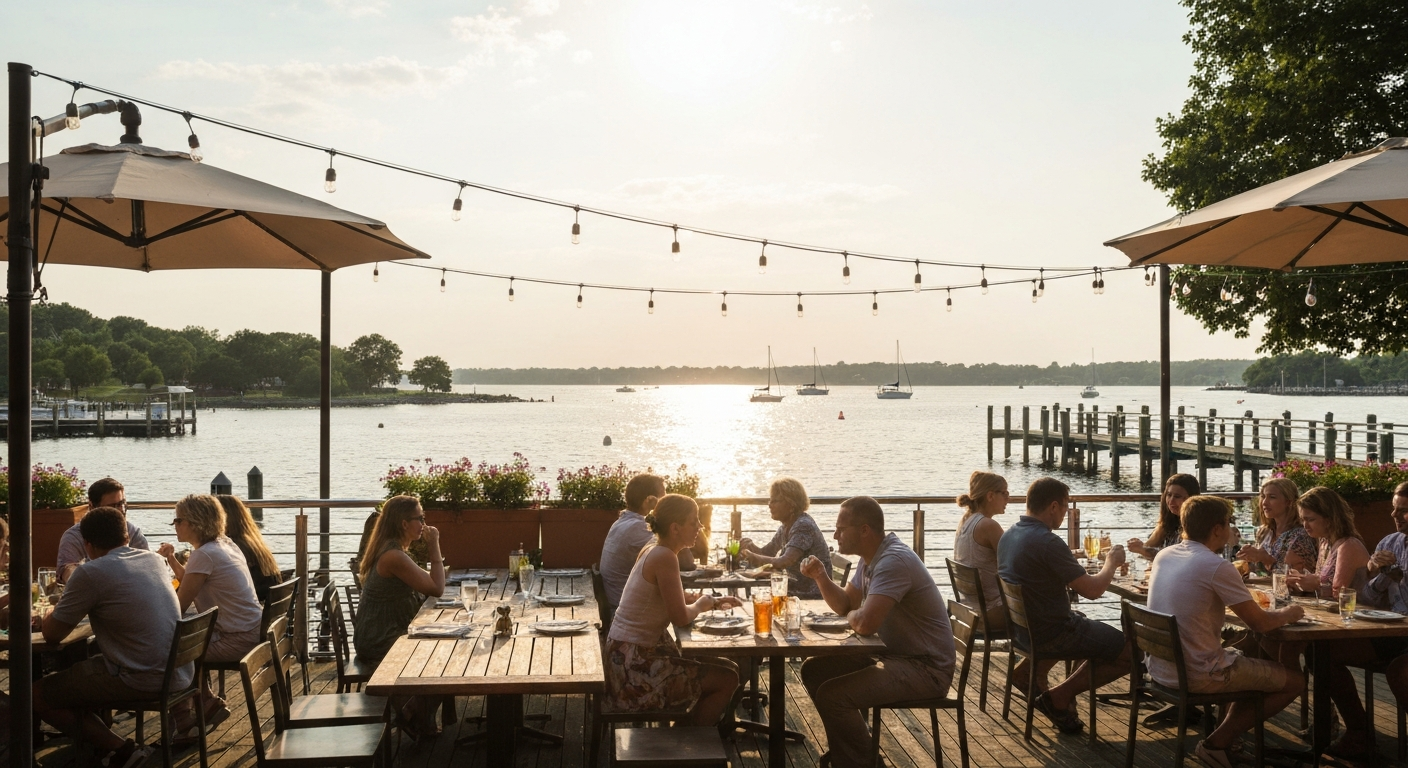
The best waterfront patios near you are hiding in plain sight: a dockside bar two neighborhoods over, a riverwalk brewery you've driven past a dozen times, a lakefront restaurant with a sunset view that would make any travel photographer jealous. Whether you're a local craving a cold drink with a water view or a traveler landing in a new city with a few hours to spare, this guide walks you through exactly how to find them, how to filter out the mediocre ones, and how to make the most of every waterfront seat you score. For a quick curated list, check our directory of best patios nearby for vetted waterfront options and photos.
Best Waterfront Patios Near Me: Local Picks & How to Find

Jonah Farrell
27 Jul 2026
Who this guide is for
If you've ever typed 'best waterfront patios near me' into your phone while standing in a parking lot or planning a weekend outing from your couch, this is written for you. Locals will get a repeatable search system they can use season after season. Travelers get a quick-start framework for any city they land in, whether that's a coastal destination or a river town they'd never thought of as a patio hotspot. The goal is the same either way: help you find a genuinely great seat with water nearby, not just one that shows up first in a paid ad slot.
What actually counts as a waterfront patio
The word 'waterfront' gets stretched a lot in restaurant marketing. The Cambridge Dictionary definition is fairly tight: a waterfront property or area directly abuts a body of water. For patio purposes, that means the outdoor seating area is adjacent to, or has a clear unobstructed sightline over, an actual body of water. A rooftop with a partial water glimpse four blocks away doesn't quite make the cut. Here's how the main types break down.
- Oceanfront: seating sits on a beach, bluff, or boardwalk with the open ocean as the backdrop. Think crashing waves, salt air, and strong afternoon wind. Shade is usually at a premium.
- Bayfront: calmer water, often with marina views, moored boats, and a more sheltered seating environment. Bay patios tend to be more comfortable for lingering lunches.
- Riverwalk: patios built along a managed riverfront promenade or embankment. Some are at water level; others sit on elevated decks above the bank. Foot traffic from the walkway adds energy.
- Lakefront: typically quieter and more residential in feel, especially on smaller lakes. Great for long dinners, often with kayaks or paddleboards in the background.
- Pier and dockside: seating is actually built on or directly beside a working or recreational pier, dock, or marina slip. You're often surrounded by water on multiple sides. These can have the most dramatic feeling of being 'on the water' but can also be exposed to wind and wake.
- Seawall and bulkhead: patios behind a reinforced coastal or riverbank wall. The water is right there, but you're separated by a hard edge. Still genuinely waterfront, just with a more urban, engineered feel.
A useful edge-case rule: if the venue's outdoor seating would be affected by a high-tide event, it's waterfront. NOAA's shoreline mapping program classifies coastal boundaries using tide datums, and the legal shoreline in most U. Refer to NOAA Tides & Currents, Tide Datums and Glossary for official definitions of tide datums (e.g., mean high water, mean lower low water) used to establish legal shorelines NOAA Tides & Currents — Tide Datums and Glossary. S. states falls at mean high water. If a patio sits between mean high water and the water's edge, it's the real thing. If it's two streets back with a rooftop claim, it's not. That distinction matters when you're choosing between options.
How to run a solid 'near me' search on your phone
The single biggest mistake people make with 'near me' searches is not having location permissions turned on, or having them set to 'approximate' rather than 'precise.' If Google or another mapping app doesn't know where you actually are, your 'near me' results could be pulling from a general city radius rather than your specific block. Here's a step-by-step approach that consistently turns up better results. Try searching for 'best patios near me with outdoor seating' to prioritize listings that explicitly advertise usable outdoor seating and get more relevant results.
- Open your phone's Settings and go to Privacy or Location Services. Find your browser and maps apps and set location access to 'While Using the App' with Precise Location toggled on.
- In Google Maps or Google Search, type 'best waterfront patios near me' or try synonyms like 'patios on the water near me,' 'outdoor dining by the water,' or 'waterfront bar with patio.' Each phrasing surfaces slightly different results.
- Tap the 'Nearby' or map view option so you're looking at pins, not just a ranked text list. The visual layout helps you spot clusters and see how close the water actually is.
- Filter by 'Open Now' if you need somewhere immediately, or by hours to plan ahead. Many good waterfront spots close early in the off-season.
- Check the photo section before tapping through to a venue. User-uploaded photos from the patio itself (not the interior) are the fastest indicator of what the actual water view looks like.
- If results feel thin, zoom your map out by 20-30% and search again. Waterfront venues are often just outside the default near-me radius, especially in suburban areas.
- Use the 'Directions' tab to get walking or transit distance, not just driving. Some of the best riverwalk and dockside patios are easier to reach on foot than by car.
On desktop, the same approach applies: make sure your browser has permission to access your location, and use Google Maps in the browser for the most accurate pin-level results. For embedding interactive maps with markers, directions, and transit/parking layers into a site or guide, use the Google Maps Embed API, Developers (Embed a map) Google Maps Embed API — Developers (Embed a map). If you're planning a trip to a city you're not currently in, search '[city name] waterfront patios' and then use the street view and photo tools to preview the actual seating area before you commit.
Using directory filters to actually narrow things down
A good patio directory, including this one, lets you layer filters so you're not wading through a hundred listings to find the three that fit your afternoon plans. Here's how to use those filters strategically rather than just accepting the default sort order.
- City and neighborhood: always start with the smallest geographic unit that makes sense. 'Waterfront patios in South Beach' is more useful than 'waterfront patios in Miami.' Neighborhood filters eliminate venues that are technically in the city but nowhere near where you're spending your day.
- Venue type: restaurants, bars, and breweries have different patio vibes even when they share the same water view. A waterfront brewery tends toward casual, communal, and affordable. A waterfront restaurant may require a reservation and offer a full dinner menu. A waterfront bar might be best for late afternoon rather than a full meal.
- Hours: filter for lunch service if you want a midday seat. Many waterfront venues fill up fast at dinner, but have open tables between 11am and 2pm. Filtering by 'serves lunch' surfaces options that travel guides often overlook.
- Dog-friendly: this is a specific amenity flag worth filtering for separately. Many waterfront patios allow dogs in their outdoor areas, but the policy varies and is governed by local health department rules (the FDA Food Code generally restricts pets in food service areas, with exceptions for service animals). Always confirm the current pet policy with the venue directly before bringing your dog.
- Amenities: shade/cover, reservations accepted, live music, parking, and accessibility (ADA-compliant route and seating) are the filters that save the most wasted trips. Check more than one at a time if you have non-negotiable requirements.
Once you've applied filters, don't rely only on the top-ranked result. Scan the second and third page of filtered results. Algorithms favor venues with more reviews, which often means newer or less-discovered spots with great views get buried. Browsing past the first few results is where locals find their real favorites, and it's worth the extra two minutes.
Reading map results and photos like a pro
Map pins and star ratings tell you where a venue is and roughly how people feel about it, but they don't tell you whether the patio actually faces the water or whether it's blocked by a fence and a service road. Here's what to actually look for once you have pins on a map.
- Pin location relative to the waterline: zoom into the satellite view and check whether the venue's pin sits directly on or adjacent to the water's edge. A venue pinned two blocks inland with 'waterfront views' in the name is a yellow flag.
- Street View: drag the Street View icon to the venue's entrance and then look for the patio area. You can often rotate the view toward the water to verify the sightline and get a sense of sun exposure and crowd density.
- Photo categories: most listing platforms separate photos by 'outside,' 'patio,' and 'food.' Go to the outdoor/patio photos first. Sort by most recent, not most popular, to see current-season conditions, including whether construction or landscaping has changed the view.
- User-uploaded vs. owner-uploaded photos: owner photos are usually the best lighting and best angle. User photos show reality, including shade coverage at 2pm on a Tuesday, whether the seating is cramped, and what the water actually looks like from your chair.
- Satellite imagery of the shoreline: for pier or dockside venues, satellite view confirms whether boats are moored alongside the patio (great atmosphere) or whether the dock is mostly decorative.
It's also worth cross-referencing what you see on Google's map with the venue's own website photos. Venues control their website imagery and will usually show their best patio shots there. If the website's patio photos don't feature the water prominently, that tells you something about how central the view actually is to the experience.
Waterfront patio features at a glance
Before committing to a venue, it helps to compare the features that actually affect your visit. Use this table as a quick-reference framework when you're evaluating two or three options side by side.
| Feature | What to look for | Why it matters | How to verify |
|---|---|---|---|
| Water view quality | Direct sightline, no obstructions | The main reason you're going waterfront in the first place | Street View, recent user photos |
| Shade and cover | Umbrellas, permanent awnings, pergolas, or trees | Comfort on sunny or light-rain days; critical for lunch | Patio photos, venue website |
| Dog policy | Explicitly listed as pet-friendly on patio | FDA Food Code restricts pets in food areas; policies vary | Call the venue or check their website directly |
| Lunch hours | Opens before 3pm with food service | Waterfront lunch seats fill fast; many spots close between service | Google hours, venue menu page |
| Full menu vs. bar only | Full food menu vs. drinks and apps only | Affects whether this works as a meal destination | Online menu or Yelp/TripAdvisor listing |
| Reservations | OpenTable, Resy, Tock, or direct booking | Essential for dinner on weekends; walk-ins riskier at popular spots | Reservation platform or venue booking page |
| Parking | On-site lot, validated garage, or street parking within a block | Waterfront areas often have limited parking; transit options help | Google Maps parking layer, venue FAQ |
| ADA accessibility | Step-free route to patio, accessible tables, accessible restrooms | Required by ADA Standards for Accessible Design at public dining venues | Venue website, call ahead to confirm |
| Pricing range | $–$$$$ indicator; waterfront premium is common | Helps set expectations; views often add 15–25% to check averages | Menu prices online, Yelp price indicator |
| Live music | Scheduled evenings or weekends | Adds energy but affects conversation; check venue event calendar | Venue website events page, Bandsintown, Eventbrite |
Your decision checklist before you go
Having a list of great waterfront options is only half the job. Choosing the right one for your specific outing requires weighing a few practical factors that don't always show up in star ratings. Here's how to think through each one.
View vs. exposure
The best view often comes with the most exposure. Oceanfront and pier patios can be stunning at golden hour and genuinely unpleasant at 1pm in July when the sun is directly overhead and the wind is gusting off the water. Bay and riverwalk patios tend to be more sheltered and comfortable for longer stretches. If you're planning a two-hour lunch, prioritize shade and wind protection over the most dramatic view. If you're going for one drink at sunset, go for the exposure.
Sun and shade timing
Most waterfront patios face west or southwest to catch sunset views, which means they get direct afternoon sun from roughly 2pm onward. If you're going for a noon lunch, you may be in full sun with no relief. Check which direction the patio faces (satellite view helps here) and plan accordingly. A north-facing riverwalk patio will be shaded in the afternoon but won't give you a sunset. A west-facing bayfront deck is glorious at 6pm and brutal at 2pm.
Noise and atmosphere
Live music is a great amenity if you're there for the vibe, but it makes it nearly impossible to have a real conversation at the table next to the speakers. Check the event calendar before you go. If the venue has live music on Friday nights and you're planning a long dinner where you want to actually talk, go Saturday at lunch instead. Waterfront venues near marinas or active boardwalks also have ambient noise from boats and foot traffic. That's part of the charm, but it's worth knowing in advance.
Service pace and crowd expectations
Popular waterfront patios at peak times can have slow service, not because the staff is bad, but because outdoor dining is harder to staff efficiently and the crowd-to-server ratio gets stretched. If you're on a schedule, go during off-peak hours (before noon or after 2:30pm for lunch, before 6pm for dinner) or choose venues where you can book a reservation. Walk-in-only spots are wonderful but plan for a wait on warm weekends. Websites like OpenTable and Resy let you confirm in advance whether a venue accepts reservations for patio seating specifically.
Pricing reality check
Waterfront usually comes with a premium. Venues in high-visibility spots pay more for their real estate and licensing, and that gets built into menu prices. A waterfront restaurant will often run 15-25% higher than a comparable inland spot. That's a reasonable trade-off for a great view and a memorable meal, but it's worth knowing before you sit down. If you want the view without the full dinner bill, many waterfront venues have a happy hour with reduced bar pricing, or offer a smaller bar menu at the outdoor bar that's more casual than the restaurant's table service.
Seasonality, weather, and timing your visit right
Outdoor patio season is genuinely wonderful in its peak, but the peak varies a lot depending on where you are. Using NOAA's 30-year climate normals (1991-2020) as a baseline, here's a general picture of when waterfront patio dining is at its best across different U.S. regions.
| Region | Best patio months | Peak-season crowd risk | Main weather challenge |
|---|---|---|---|
| Pacific Coast (CA, OR, WA) | April–October (CA); June–Sept (OR/WA) | High July–August | Morning fog, coastal wind |
| Gulf Coast (TX, LA, FL Panhandle) | October–April | High Nov–Feb (snowbirds) | Heat and humidity May–Sept |
| Southeast Atlantic (FL, GA, SC) | October–May | High Dec–March | Summer thunderstorms daily 3–6pm |
| Mid-Atlantic (DC, MD, VA, NJ, NY) | May–October | High July–Aug | Humidity spikes, afternoon storms |
| Great Lakes (IL, MI, OH, WI, MN) | May–September | High July–Aug | Wind off lakes, cold snaps in May/Sept |
| Gulf of Mexico (TX coast) | Nov–March, Oct | Moderate | Hurricane season June–Nov |
| Interior rivers (TN, KY, MO, AR) | April–October | Moderate | Spring flooding risk near river level |
One underappreciated seasonal factor: mosquitoes. In many inland waterfront areas (rivers, lakes, bayous), mid-to-late summer brings peak mosquito activity and, in some regions, elevated West Nile virus risk. The CDC tracks West Nile seasonality by state, with peak transmission typically occurring from mid-July through September. If you're visiting a lakefront or riverwalk patio during that window, check whether the venue has fans, citronella features, or enclosed areas as fallback options, and consider bringing insect repellent for evening visits.
Rain plans and weather extensions
The best waterfront patios have some kind of rain contingency, whether that's a retractable awning, a permanent hard-cover pergola, or a quick transition to a covered indoor bar area. Before booking a waterfront patio on a day with a mixed forecast, check the venue's photos for evidence of cover structures. NFPA guidelines govern outdoor heater safety (propane and natural gas units require specific clearances and ventilation standards), so venues that invest in proper weather-extension infrastructure tend to have thought through the overall outdoor experience more carefully. Patios with outdoor heaters, solid awnings, and misting systems are worth noting as year-round options rather than just fair-weather picks.
Beating peak-season crowds
The best waterfront seat in a city is often occupied by someone who showed up at an unexpected time. Saturday at 6pm in July is peak competition. Thursday at 12:30pm in May is an entirely different experience at the same venue, often with the same view and a shorter wait. If you can be flexible, the shoulder months (May and September in most of the country) offer warm enough weather, smaller crowds, and full menus. Early lunch on weekdays is consistently the most underrated window for waterfront patio dining.
How to contribute and keep the directory growing
Discovering a great waterfront patio you didn't know about is one of those small, genuinely satisfying experiences. When you find one, verify the basics directly with the venue (hours, pet policy, reservation availability) before relying solely on third-party listings like Yelp or TripAdvisor, which can lag behind real-world changes by weeks or months. If you're bringing a pet, consult directories of the best dog friendly patios to confirm leash rules and outdoor seating availability. For patrons with pets, check our curated list of the best dog-friendly patios near me to confirm policies and amenities before you go. The venue's own website and a quick phone call are still the most reliable sources for current information. Once you've been, submitting a review, a patio photo, or an update to the directory helps the next person searching 'best waterfront patios near me' skip the guesswork and get straight to the view. When you submit a review or photo, include searchable phrases like "good patios near me" so others using that query can find your recommendation quickly. That's the whole point.
FAQ
What definitive editorial definition of 'waterfront patio' should I use for local filtering and copy?
Use a clear, verifiable definition that distinguishes direct water access from mere water views. Example editorial rule: 'Waterfront patio = outdoor dining space that directly abuts or is built on/over a water edge (oceanfront, bay, riverwalk, lakefront, pier/dockside) or sits on public shoreline property immediately contiguous with the waterline.' Cite dictionary guidance for 'waterfront' (Cambridge) and NOAA shoreline terminology to support category rules. For ambiguous cases (rooftop or elevated view only), label as 'water‑view patio' rather than 'waterfront.'
Which authoritative sources define shoreline boundaries and public vs. private waterfront access I should check when verifying a patio?
Use NOAA resources: NOAA Shoreline Mapping/CCoast for shoreline and structure terminology and the NOAA Tide Datums glossary (mean high water, mean lower low water) to establish legal shoreline limits. These documents help determine whether a venue 'abuts' water, whether patios are over/above tidally influenced areas, and public access constraints.
What local environmental and seasonality data do I need to include for accurate month‑by‑month patio guidance?
Include 30‑year climate normals (NOAA NCEI) for average temperature, precipitation and seasonal windows; NOAA Tides & Currents station predictions and real‑time water levels for coastal scheduling and high‑tide impacts; and CDC/state public‑health mosquito/arbovirus season pages to flag peak mosquito risk. Use these sources to recommend best months, typical weather risks, and scheduling cautions.
What venue facts must be collected and how should they be verified?
Collect: official name, full address (including neighborhood), phone, website URL, Google Business Profile link, hours (including lunch/service times), patio type (pier, dockside, riverwalk, lakefront), seating capacity, dog/pet policy, ADA accessibility notes, reservation policy and booking links, menu/pricing or sample lunch menu link, live‑music schedule, parking/transit options, and seasonal/temporary closures. Verify in this order: venue official website and direct phone/email (primary), Google Business Profile (principal discovery surface), then aggregator listings (Yelp, TripAdvisor) as secondary corroboration. Update cadence: weekly for high‑traffic lists, monthly otherwise.
Which legal, health and accessibility rules should be checked and cited when listing dog‑friendly or accessible patios?
Cite the FDA Food Code for rules on animals in food establishments and ADA guidance on service animals (exceptions). For physical accessibility, use ADA Standards for Accessible Design (1991/2010) to create a checklist (clear accessible route to patio, table knee clearance, accessible restrooms, door thresholds, ramp slope). If a venue advertises 'pets allowed,' confirm local health department rules and whether patios are managed as separate outdoor dining areas where pets may be permitted.
What practical decision criteria should be included in the guide and quick‑compare tables?
Include: view type (direct water vs. water‑view), shade/cover (awnings, umbrellas, heaters), weather‑extension features (heaters, wind screens), dog policy (pets allowed/service animals), lunch hours/menus, reservation vs. walk‑in policy, group booking limits, parking/transit/proximity, ADA accessibility, pricing level, live music/noise policy and typical schedule, mosquito/seasonal risk, and permit/municipal compliance (if relevant). Present these in a concise quick‑compare table for each city/venue type.
Next Article
Best Dog Friendly Patios: How to Find the Right Place
Find the best dog friendly patios with filters, checks, and comfort tips so dogs stay leashed, cool, and welcomed.